SPACINGS
Sonic Arts Research Centre
Three immersive works created by SARC artists and researchers. Curated by Pedro Rebelo for the Festival, the show explores ways of engaging with room size projection and immersive sound in an intimate setting. The works deal with space in very distinct ways, from an abstraction of the domestic in Hamilton’s work, to an interaction in the public domain (Brooks) and virtual space (Griffin).
Tunnel | Andrew J Brooks | 13 – 20 October
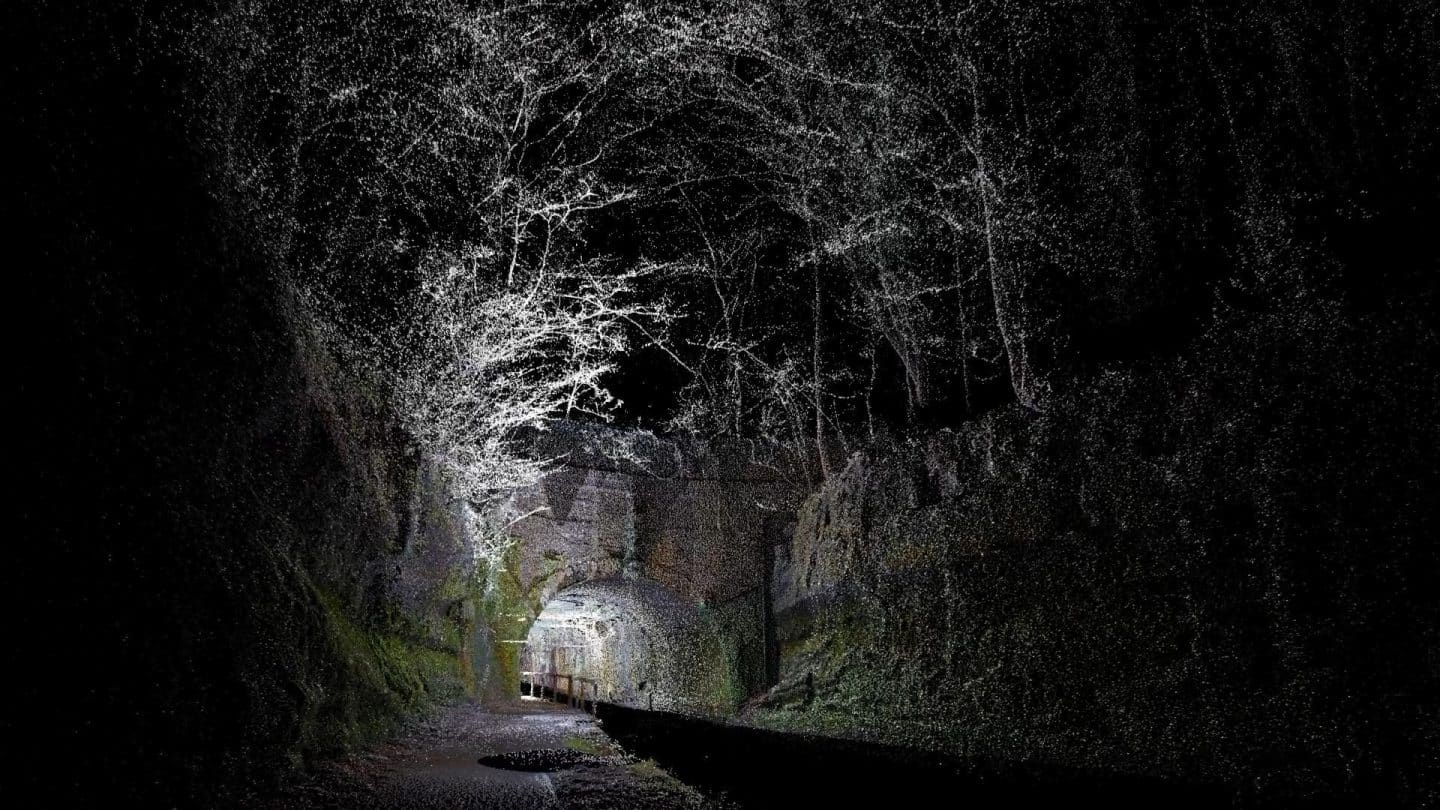
It takes approximately ten minutes to walk the length of the tunnel on the Union Canal at Falkirk High — depending on how often you stop to listen.
This film and audio is layered over a mobile phone recording made while walking through the tunnel on 20 November 2025. On 9 January 2026, Brooks returned with a 3D laser scanner, an ambisonic microphone, a contact microphone, and a pair of hydrophones to capture the tunnel’s many sonic layers: thundering water, drips on the balustrade, the natural resonance of stone and water, and the hidden conversations that emerge within shifting patterns of sound.
No audio effects have been added. The piece is constructed solely through fades between recordings made with the different microphones, presenting the tunnel as it was heard through each listening technology.
M E R C Y | Vivienne Griffin | 22 – 29 October
M E R C Y is a video work in two parts. The first section is a text based video work allegorizing a collective unconscious nervous breakdown. For the sound, a melancholy folk song accompanied by guitar is put through a generative algorithm, turning it to noise. The black and white text video uses a speed reading technique, it consists of multiple voices which are communicating about disparate subjects. One voice describes the potential smell of a digital rose, another voice recounts, in great detail, the memory of a 10 second video they viewed and yet another is an internal monologue on speed.
The second part of M E R C Y was made with Turing Institute researcher, lawyer and court advocate Cari Hyde-V aamonde. Part two uses visual metaphors in a virtual world to describe complex systems in Cari’s research. For example – the maze describes black box Ai, the rubbish in the maze refers to datasets which are dirty. The stairways within M E R C Y refer to decision tree branching algorithms. M E R C Y takes on the problem of explaining complex systems, removing the barrier to understanding through visual prompts and metaphors within the video.
Through this work the idea of the despotic binary is explored. The despotic binary refers to the binary on/off, yes/no, 0/1, that in some way explains the polarization of politics, and the echo chambers that exist online. However, within the sound, the text and the virtual world there is also a constant search for the emancipatory prompts within technology, machine and human interaction.
Credits
- Research from Cari Hyde-V aamonde, 2021 – 2022.
- Video, Unreal Engine environments, MAX Msp visual coding for sound, voice, guitar, modular synthesizer
- Writing, Direction, Editing, Environments, Animation, Music and Sound: Vivienne Griffin
- With research from Cari Hyde-V aamonde, Turing Institute.
- Mastering Enyang Urbiks, Urbiks Music.
- M E R C Y was R + D funded by King’s College London and Somerset House.
On Wanting | Helena Hamilton | 3 – 10 November
On Wanting (Iteration II) is a sound and moving-image work rooted in Helena Hamilton’s lived experience of early motherhood.
Recordings drawn from domestic life are edited and recomposed into a spatial composition, accompanied by a slow transition from white towards yellow. The work emerged from a period in which everyday routines, objects and spaces had taken on a new intensity.
Presented across three projected walls, with sound distributed throughout the gallery, On Wanting expands private, everyday material into a shared encounter. Its gradual pace allows subtle changes in colour, texture and sound to accumulate, making the familiar unfamiliar.